Char Siu Pork Belly in Traditional Homemade Marinade (No Colour)
A Chinese chef shares her Hakka family’s secret Char Siu marinade for the juiciest pork belly. Get a perfect red glaze without artificial colour.
- Cooking time90 mins
 Calories581kcal

In this final instalment of our four-part series with Jessie Yung—chef and co-founder of Jessie Yung’s Kitchen—she generously shares her prized recipe for Char Siu. This recipe is particularly special because Jessie inherited it from her mother.
Growing up in Calcutta, Jessie remembers her mother cooking char siu in a covered wok because like most Bengali homes they didn't have an oven. Her marinade relies on basic Chinese pantry staples, since it is from a time before bottled char siu sauce was available in the city.
To achieve the vivid red hue we associate with the dish, Jessie sticks to the traditional ingredient: red yeast rice. This natural pigment stains the meat and fat with a depth that synthetic colors cannot match. Using the same versatile marinade, Jessie teaches us two versions—one with chicken and another with pork.
For the pork char siu, she prefers pork belly because of how decadent a pork belly char siu turns out. We hope you enjoy making this recipe!
Jessie runs her much-loved cloud kitchen, Jessie Yung’s Kitchen, in Calcutta with her husband Peter and her two children. Started during the pandemic, Jessie’s takeaway-only menu has a dedicated following. They intentionally steer clear of usual Chinese restaurant fare, choosing instead to feature Hakka and Cantonese homestyle dishes, as well as dishes from the different parts of China and South East Asia that Jessie learns on her travels.

🌟 Why you can rely on this recipe
Jessie Yung is a traditional Hakka Chinese chef who inherited this char siu recipe from her mother, and then refined it over the years for their Chinatown restaurant, Namking, and later on for Jessie Yung’s Kitchen! This Char Siu belly pork is the signature dish on her menu today and for a reason!
Jessie has cooked this all her life and still does almost every day. So, she cooks by instinct. We worked with her to measure and time everything so that we could share it Bong Eats viewers.
Like with every recipe on Bong Eats, we don’t just measure once. We then used our measured recipe to cook this char siu several times over the last year to double-check and fine tune it until we were satisfied. We reached out to Jessie with our questions about every step, and she obliged us with her expertise and knowledge.
In short, yes, you can trust this recipe.
Can I make char siu without an oven? In a pot? On a stove?
Yes, you can. In fact, in our char siu video Jessie mentions that like most Indian families her family did not own an oven, growing up. Her mother used to cook this char siu pork recipe in a wok with the lid on.
In her Losar Roast Pork Roast recipe Doma Wang showed us a similar technique. You can watch it here.
Here is how you can adapt this recipe to a pot or wok.
- Sear and Steam: Heat a heavy-bottomed pot until very hot and coat it with a thin layer of neutral oil. This helps season your pot and prevents the meat from sticking. Lower the heat and place the strips of marinated pork in the pot. Add a splash of hot water and cover with a lid.
- The Slow Cook: Cook gently for 40 minutes. Check periodically to ensure the water hasn't evaporated. There is a high sugar content in this marinade, so it can burn easily if you aren’t careful!
- Testing for Doneness: After 40 minutes, insert a skewer or knife to check if the meat is tender. If not, continue cooking covered, adding small amounts of water as necessary to keep the environment moist.
- The Final Glaze: Once the pork is cooked through, remove any excess sauce and reserve it for serving. Coat the pork in its glaze and sear over medium heat until the sauce thickens and the pork begins to char. Be vigilant at this stage—do not walk away! When you are happy with the char, remove the char siu and serve.
Can I make char siu without artificial colours?
The red colour of a good char siu comes in a large part through a combination of the caramelised rock sugar and the cooking technique. If you watch Doma Wang’s roast pork recipe, you will see that it has a pleasing hue even without any added pigment. That is the natural colour you can expect to achieve without any extra colouring agents.
If, however, you want the vibrant red colour that is associated with char siu, you can choose either artificial or natural colours.
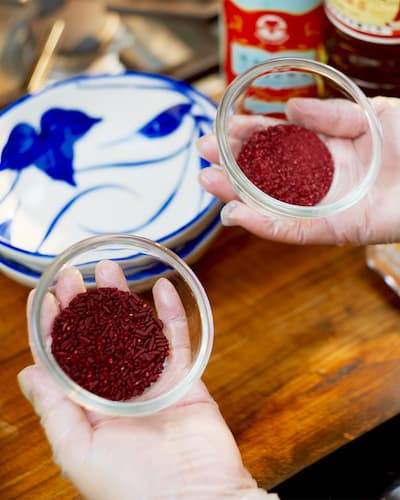
In this recipe Jessie uses Red Yeast Rice which is the most traditional way to colour char siu in Chinese cooking. Red yeast rice produces the most natural looking red char siu, and the colour is retained in an acidic environment. Don’t confuse red rice yeast with goji berries which look somewhat similar but don’t do anything for the colour.
If you can’t find red yeast rice, an alternative is Red Fermented Bean Curd (nam yu) which is tofu dyed with red yeast rice.
If you can find neither, feel free to use a red food colour of some kind. Of course, if you don’t mind the natural look, as we said in the beginning, skip the colour. It will taste just as good.

Choosing a pork belly for char siu
To make a truly great char siu pork belly you have to start with a good piece of pork belly. Jessie recommends a belly with at least five distinct layers—skin, fat, meat, fat, and meat. These alternating layers of fat sandwiching the lean meat produces the most melt-in-the-mouth texture.
This muscle structure is what makes this char siu different from a char siu made with pork shoulder or pork loin. A char siu made with pork belly is truly the most decadent avatar or this dish—especially for someone who likes the richness of the fat.
Ingredients for a traditional char siu marinade
Jessie mentions that her mother’s traditional Chinese BBQ marinade contained no store-bought Lee Kum Kee Char Siu Sauce—simply because it wasn't available in Calcutta at the time. Instead, it relied on basic Chinese pantry staples: hoisin, oyster sauce, and soy sauce, along with their homemade rice wine (a fixture in any Hakka household), toasted sesame oil, white pepper, and sugar.
Times have changed. Even though bottled sauces are now readily available in New Market, Jessie still relies on her time-tested family recipe. While she uses a bit of Lee Kum Kee Char Siu Sauce for the viscosity it adds to the marinade, she stresses that even this is optional.
Where to find specialty Chinese sauces in Calcutta
This dish uses a few ingredients which may not be in your pantry, such as the Chinese black bean, oyster sauce, dried shiitake mushrooms, etc. These are all readily available in New Market. We purchased them from Nasiruddin Sardar who runs Shop no. 39A in the spice lane inside New Market.
Frequently Asked Questions
How do I make a large batch of char siu?
Char siu is perfect for batch cooking since the effort to make a small or a large batch is the same. You can double or even quadruple this char siu marinade recipe. We recommend a dual approach using the fridge and the freezer to cook large batches.
First, coat all of the meat in the marinade. Next, decide how much char siu you can use up in a three-day span. Put that portion of the marinated char siu in the fridge in an airtight box or bag. You can cook this batch in one or two days and keep the leftovers in the fridge for another three days.
Divide the rest of the marinated meat into as many portions as you like, put them in airtight containers and store them in your freezer. This can last in the freezer for upto three months.
Twenty four hours before you want to cook your next batch, move the container from the freezer to the fridge. Two hours before the char siu is about to go into the oven—or one hour if the room temperature is above 32º C—take the container out from the fridge and leave it on your kitchen counter.
Then bake them per the instructions and store the leftovers in the fridge for the next 2–3 days.
If you have any questions you can always ask us on our membership community.
Which cut of meat? Pork belly vs pork shoulder vs pork loin
As we have discussed in the Choosing a pork belly section, a pork belly char siu is the most decadent version of char siu in. Because of how the meat is sandwiched between thin layers of fat, the texture of this char siu is juicy and luscious.
Boston butt or bone-in pork shoulder: If you prefer a more balanced texture with more meat and less fat, choose a cut from the pork shoulder. If you are trying to find a good pork shoulder in Calcutta, you have to get to the butcher early in the morning because this cut is highly prized among restaurants! You can ask them to remove the skin and the top layer of fat for you. If you are a member of Bong Eats Adda we have a community-curated list of the best pork shops in Kolkata, Mumbai and Bangalore there.
Pork loin: This is going to be the leanest among all cuts of pork. The char siu using pork loin is going to be meaty with almost no fat. Because this cut is so lean you may need to cook this for a shorter duration than the pork belly.
Cleaning the pork for char siu
Washing meat thoroughly is an important part of traditional Chinese cooking. If you watch the char siu video you will see how rigorous Jessie is about cleaning the pork. She rubs the meat with a slurry of plain flour and water first. Then she fills a bowl with water and scrubs the pork belly, and finally drains the water. She does several times until the water runs clear and the meat’s colour changes to pale.
Plain flour is surprisingly good at removing any odour and slime. My Bengali mother also uses atta (wholewheat flour) to clean fresh fish from the market.

Is there a substitute for the Lee Kum Kee char siu sauce
You don’t need the Lee Kum Kee sauce for Jessie’s char siu marinade. She adds it only for its thickening property. It helps the marinade stick. She mentions in the video that her mother’s char siu recipe did not have the Lee Kum Kee char siu sauce. The flavours of this char siu marinade comes from Chinese pantry staples.
What is Chinese five spice?
Chinese five spice can be thought of as the Chinese equivalent of South Asian gorom moshla. Just like garam masala there are many variations—often more ingredients are added, frequently the proportions change. Ingredients such as cassia, clove, star anise, fennel, sichuan peppercorn, and dried sand ginger are common.
Why is there no salt in the char siu marinade recipe?
The Chinese BBQ sauce ingredients include soy sauce, hoisin sauce, and oyster sauce all of which contain salt. If you follow our measurements you should not need to add any additional salt.
How long to marinate char siu?
The meat in a char siu must marinate for 24 hours for the salt to penetrate all the way and for the flavours to meld. The marination period also helps stain the meat more deeply. Char siu can be marinated longer, upto three days in the fridge. See our section on batch cooking char siu for how to store marinated char siu for even longer periods.
Where do you store the marinated char siu—fridge or freezer?
In the fridge if you are planning to cook it within 2–3 days. Any longer, you should put the marinated meat in the freezer. Twenty four hours before you plan to cook, move the frozen char siu from the freezer to the fridge for it to gently thaw.
How to defrost char siu
Move it from the freezer to the fridge twenty four hours before you plan to cook. Both for safety as well as better texture thaw marinated frozen meat in the fridge.
Can I make the char siu glaze without maltose?
If you don’t have maltose, you can use Jessie’s method of using rock sugar with a splash of water, and a squeeze of lime to make a thick glaze. Honey can be an option too.
What is rock sugar used in Chinese recipes?
Rock sugar is a type of unrefined sugar made by crystallising a supersaturated sugar solution. The sugar solution can come from sugarcane juice or palm sap. Most Bengalis will know rock sugar as taal-michhri. The iconic Dulal Chandra Bhar’s taal michhri bottles we grew up with should come in handy for this recipe!
Temperature Guide: When is char siu pork belly done?
The easiest way to judge the doneness of pork belly char siu is to poke it with a skewer or thin knife. There should be almost no resistance. If you have a probe thermometer aim for an internal temperature between 90–95ºC, specifically for pork belly.
As you can see, this is a pretty high temperature. This high temperature helps the fat render and gives you the melt-in-the-mouth texture you want from this cut of meat. It’s not a matter of food safety. Pork belly is safe to eat at 65ºC, but the eating experience of pork cooked to 65 degrees is going to be chewy and unpleasant.
What to serve with Chinese BBQ pork
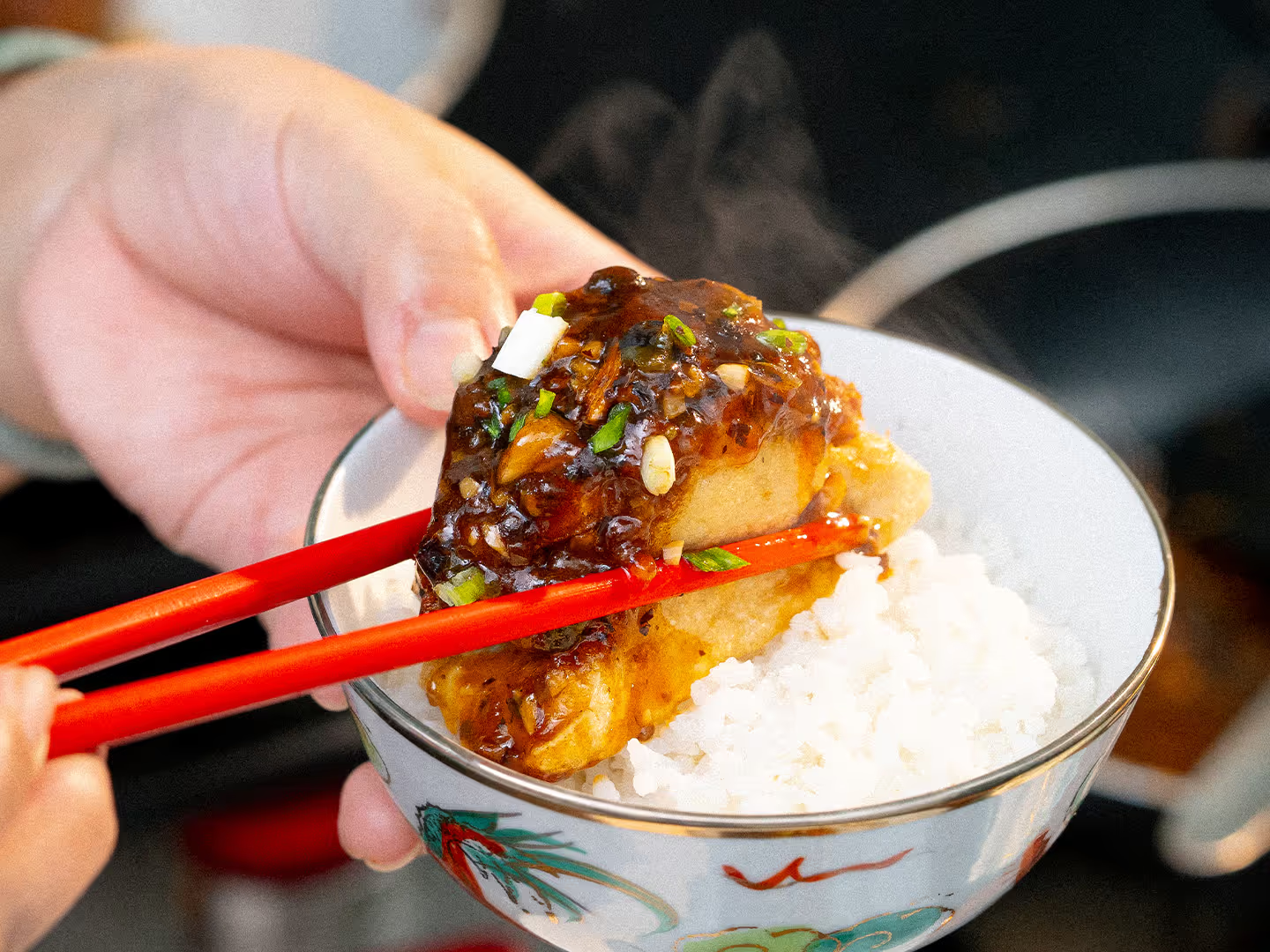
The char siu pork belly is fatty, rich and bright red. So, Jessie likes to serve it with something fresh and green to counter the richness and create a visual contrast. Slices of cucumber, crisp lettuce, blanched bok choy or other seasonal greens are perfect companions. Serve this on a bed of plain rice with some of the leftover char siu sauce in a bowl.
Jessie recalls eating sandwiches made with leftover char siu pork when they returned home from school.
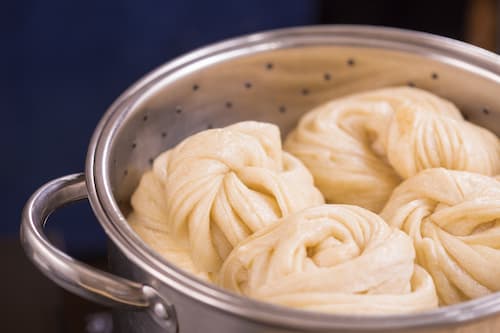
Another personal favourite to go with char siu are steamed Tibetan buns.
Best way to reheat char siu pork
If you are looking at this answer, you are probably someone who is seeking an option that is better than the microwave, right? For leftover char siu that looks and tastes just as good as the freshly baked, heat it in two stages.
First, set your oven to 120º C and place the leftover char siu inside. No need to preheat the oven. This will gently warm the meat through and bring it up to temperature. This can take 30 minutes to 45 minutes for the size of meat shown in our video.
Once the meat is cooked through, you can finish on high heat. This can be done under the broiler and will only take a few minutes. A quick sear with a blow torch or over an open flame is another great option.
Ingredients

- 1 kg pork belly (divided in 5-cm sections)
For the marinade
- 30 g char siu sauce
- 40 g hoisin sauce
- 45 g oyster sauce
- 8 g soy sauce
- 12 g rice wine
- 8 g toasted sesame oil
- ¼ tsp red rice yeast (powdered)
- ¼ tsp Chinese five-spice powder
- ¼ tsp pepper
- 10 g sugar
For the glaze
- 20 g rock sugar
- 40 g water
- 4 g oil
- ¼ tsp lime juice
Method
- Scrub the pork belly clean using some flour as abrasive. Wash and rinse multiple times until the water runs clear. Pat dry completely.
- Remove the skin, and divide the pork in 5-cm-thick strips or sections.
- Prick the meat to allow the marinade to seep in.
- Mix all the ingredients of the marinade together. Massage it into the meat.
- Transfer to an airtight container, and let it marinate for at least 24 hours in the fridge. If you intend to cook this at a later date, store it in the freezer. It'll keep for months!
- When you are ready to cook, take the meat out of the freezer and let it defrost completely.
- Lay it out on a foil-lined baking tray, and cook in a 180°C oven for 40 mins.
- While the pork is cooking in the oven, prepare the basting liquid and the glaze.
- For the basting liquid: Transfer any leftover marinade to a small bowl. Microwave it for 1 minute. Set aside.
- For the glaze: In a saucepan, add the rock sugar, water and oil, and cook until the sugar dissolves and turns slightly brown. Squeeze in some lime juice to check crystallisation. Remove in a small bowl and set aside. It will become thick and sticky as it cools.
- Once the pork is out of the oven, baste it and place it back in the oven at 150°C for 15 mins.
- After that, take the tray out once again, brush on the glaze, and put it back in the oven one last time at 200°C for just 2 mins until the top is glassy.
- Allow it to cool slightly before slicing. Serve with fresh greens like lettuce, cucumber or blanched bok choy.